Pages

29 September 2009 NOD32 latest escalation ID

  • Username: EAV-22254510
    Password: r87v5f2xpr
  • UserName: EAV-17440697
    Password: 553df2ac7v
  • UserName: EAV-17442243
    Password: fmk8hsjk4v
  • Username:EAV-21911559
    Password:uhkhk2jr27
  • Username:EAV-17439511
    Password:55jpxa6sfj
  • Username:EAV-20282038
    Password:c64a22krun
  • Username:EAV-20449260
    Password:xhhk3j4b4e
  • Username:EAV-21587910
    Password:8677vhkdk7
  • Username:EAV-20433592
    Password:tm7kdv6vbd
  • Username: TRIAL-22188115
    Password: f5enfr4s3d
  • Username: TRIAL-22318139
    Password: t7j3hejnex

A virus was detected by nod32,What should I do?

Basic rules to follow if a virus is detected:
1. trojans can only be deleted as they do not infect other files and contain only their own code.
2. worms in email attachments should be deleted as they contain only the viral code
3. if the IMON's HTTP scanner detects a virus, choose to terminate the connection to prevent it from saving to the disk (in the case of a probable NewHeur_PE virus,

If you are unsure whether it is safe to delete the particular file without any side effect on your system's functionality, we suggest you tick the Copy to quarantine checkbox before you choose to delete it. Please bear in mind that most viruses copy themselves to system folders such as windows or windows\system32 to confuse the user. Should you have any concerns about deleting the file and were unable to find any description of it neither on our website nor on the web, please send the suspicious file to support@nod32.com for analysis.

26 September 2009 NOD32 latest escalation ID

Username:EAV-20282038
Password:c64a22krun

Username:EAV-20449260
Password:xhhk3j4b4e

Username:EAV-20433592
Password:tm7kdv6vbd

Username:TRIAL-22188141
Password:sjpfhphnr7

Username:TRIAL-22188125
Password:26ukrnb2mk

Username:EAV-21587910
Password:8677vhkdk7

Username:EAV-21690132
Password:kck6xe4a4b

Username:EAV-21911559
Password:uhkhk2jr27

Username:EAV-17439511
Password:55jpxa6sfj

23 September 2009 NOD32 latest escalation ID

Username: TRIAL-21864767
Password: 3hkj3t4c2a

Username: TRIAL-21597130
Password: 8m48x5f83p

Username: TRIAL-21878136
Password: ufasd7ebtk

UserName: EAV-21785711
Password: xrd4pkfupe

UserName: EAV-20728602
Password: r8pas5ev4j

Username:EAV-18410085
Password:dnhbn6ehb7

Username:EAV-21041547
Password:h6hv2aa4au

Username:EAV-18143992
Password:2kf5a6mmmh

Username:EAV-21428027
Password:fbube3t546

Username:EAV-18102837
Password:f3thj4hcje

Username:EAV-21535142
Password:nf2sdtpx86

21 September 2009 NOD32 latest escalation ID

21 September 2009 NOD32 latest escalation ID
  • Username: EAV-18143992
  • Password: 2kf5a6mmmh
  • UserName: EAV-18386094
  • Password: 3tcshcb4kh
  • UserName: EAV-18410085
  • Password: dnhbn6ehb7
  • UserName: EAV-21041547
  • Password: h6hv2aa4au
  • UserName: EAV-18410085
  • Password: dnhbn6ehb7
  • Username: TRIAL-21760674
  • Password: u427vn5un7
  • Username: TRIAL-21878080
  • Password: vde2bhkcpf

19 September 2009 NOD32 latest escalation ID

  • UserName:EAV-21428027
  • Password:fbube3t546
  • Username:EAV-21673374
  • Password:rmceufu64m
  • Username:EAV-18102837
  • Password:f3thj4hcje
  • Username:EAV-21535142
  • Password:nf2sdtpx86
  • Username:TRIAL-21760653
  • Password:jsu8c3mbsb
  • Username:TRIAL-21227318
  • Password:vpd5m58da8

17 September, 2009 NOD32 latest escalation ID

  • Username:EAV-21434712
  • Password:bvf6sxdfac
  • Username:TRIAL-21597130
  • Password:8m48x5f83p
  • Username:EAV-21114847
  • Password:3tsr6mrxx4
  • Username:TRIAL-21597132
  • Password:eb46svsx3j
  • Username:EAV-07758844
  • Password:wrnvv8mkte
  • Username:EAV-21598056
  • Password:mcbrnch6dv
  • Username:EAV-16673325
  • Password:mnsrsaubxa
  • Username:EAV-17437089
  • Password:n5e427es7a

Activation Kaspersky 2010 license using key file

The latest version of Kaspersky Antivirus and Internet Security (2010) does not allow to activate your Kaspersky product using a license key file.

The 2010 Kaspersky Lab products can be activated only by an activation code via the Internet. This becomes quite difficult if you have a valid license key file or want to Activate Kaspersky Products Offline.

Though, 2010 build don’t have the option to activate using the key file but there is a trick to do it.

Activation Kaspersky 2010 license using key file:

1. Open your Kaspersky 2010 License Manager.

2. Click Activate New License.

3. Select Activate commercial license and enter the activation license code as T1JVS-NNMBD-K1QTN-SUBP8 (beta code).

4. Click Next. Now you’ll get a dialog box as shown below, click Ok on it.
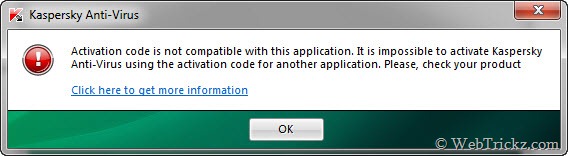
dialog box

5. That’s it. Now you will see the option of a key file to activate your KAV/KIS 2010 product.
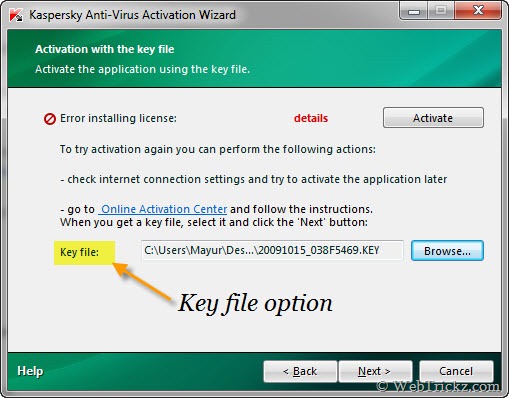
key file option in kaspersky 2010

Browse to the key location on your PC which you already downloaded and activate your product easily.


http://www.mediafire.com/?sharekey=3e019f312e9f3b217f7ec40ada4772a6c3b8e309aeed3c8df88875faa4c6c51e

15 September, 2009 NOD32 latest escalation ID

  • UserName:EAV-21114882
  • Password:s6rttmstuu
  • Username:EAV-20650833
  • Password:ntxhmrjsch
  • Username:EAV-20650854
  • Password:253f8d3d8d
  • Username:EAV-18051535
  • Password:exrr6kx63b
  • Username:EAV-18065729
  • Password:nh522sudks
  • Username:EAV-17503083
  • Password:eh5p85k444

12 September, 2009 NOD32 latest escalation ID

  • Username:EAV-21178329
  • Password:v8rrttfm65
  • Username:EAV-21178414
  • Password:j24h2apppf
  • Username:EAV-21178561
  • Password:85sumdr8jf
  • Username:EAV-21179434
  • Password:bbmnh4v67v
  • Username:EAV-20265886
  • Password:arkh8pf8cj
  • Username:EAV-20331694
  • Password:cesd2jnkad

10 September, 2009 NOD32 latest escalation ID

Username:EAV-20541617
Password:6srdsue8d8

Username:EAV-20544234
Password:pxtdf8m4th

Username:EAV-21228225
Password:dfdvte246a

Username:TRIAL-21227315
Password:ct63tfvfjx

Username:TRIAL-21227321
Password:fjk6fpja3h

Username:EAV-20831172
Password:aea6jnxu8j

Username:EAV-20806371
Password:53epdv4mtx

Username:EAV-21247677
Password:hrvfkxk3sd

Kaspersky Anti-Spam 3.0 wins a Golden Certificate from Virus Bulletin

Kaspersky Anti-Spam 3.0 wins a Golden Certificate from Virus Bulletin:

Kaspersky Lab, a leading developer of secure content management solutions announces that Kaspersky Anti-Spam 3.0 has received a Golden Certificate from the authoritative British IT security magazine Virus Bulletin.

Between 7 and 27 August, 2009, 12 of the most popular anti-spam products went head-to-head in a product comparison called VBSpam which tested their spam filtration efficiency to the maximum on identical server hardware running Windows or Linux server operating systems.

The products were tested for efficiency using more than 315,000 emails. Of these, more than 313,000 contained some spam content, including 19,400 emails from Virus Bulletin’s own spam archive and over 249,000 emails that were received in real time from the spam traps of Project Honey Pot. All of the anti-spam solutions tested received the same email flow.

All the emails sent originated from dedicated, fixed IP addresses, thus hindering the detection of spam by way of standard IP filtration technology. In order to resolve this issue, IP addresses and/or senders’ domain names were added to the email headers.


-------------- news from Kaspersky Lab.

The prestigious VB Golden Certificate is only awarded to products that can demonstrate very high levels of spam detection coupled with a low rate of false positives. Kaspersky Anti-Spam 3.0 earned its Golden Certificate by demonstrating a 98.39% level of spam detection with a minimal false positive rate of 0.63 %. Additionally, the Kaspersky solution successfully detected and blocked 99.01% of all unsolicited emails that originated from spam traps, i.e. genuine spam messages.

Virus Bulletin’s experts praised Kaspersky Lab’s solution for its above-average performance in both test parameters as well as its ease of use.

Kaspersky Anti-Spam 3.0 is a highly effective system designed to combat unsolicited email in medium-to-large sized enterprises. The solution incorporates a number of spam control technologies that are unique to the market. The exceptional effectiveness of Kaspersky Anti-Spam 3.0 is achieved through multi-layer and multi-language analysis of the email traffic received. The package of technologies utilized by Kaspersky Anti-Spam ensures the successful detection of virtually all unsolicited email messages.

08 September 2009 username and password of nod32

Username:EAV-20541617
Password:6srdsue8d8

Username:EAV-20544234
Password:pxtdf8m4th

Username:EAV-21228225
Password:dfdvte246a

Username:TRIAL-20993870
Password:chbps48hn2

Username:TRIAL-20993869
Password:2b5hta8bxj

Username:TRIAL-20993866
Password:efuf3nvd7a

Username:EAV-20830846
Password:p45sbe3ax3

UserName:EAV-21097603
Password:bc7j4n2rj5

06 September 2009 username and password of nod32

06 September 2009 username and password of nod32


Username:EAV-20541617
Password:6srdsue8d8

Username:EAV-20544234
Password:pxtdf8m4th

Username:EAV-21228225
Password:dfdvte246a

Username:TRIAL-20993870
Password:chbps48hn2

Username:TRIAL-20993869
Password:2b5hta8bxj

05/09/09 Nod32 Username And Password

UserName: EAV-20853674

PassWord: md8cj5k8ke


UserName: EAV-20854285

PassWord: txu24db8vn


UserName: EAV-20854286

PassWord: 754646bem5


UserName: EAV-20854306

PassWord: jd75mss3h2


UserName: EAV-20854329

PassWord: m3pe63a2tp


UserName: EAV-18476451

Password: ab3 aus4n28

How do I temporarily disable the startup scan?

ESET security product will scan programs and memory at startup. If your system startup scan is taking an unusually long time to complete, you may have conflicting programs set to run at start up. You cannot cancel the startup scan once it has started, but you can temporarily disable the scan from running on system startup by following the directions below:


  1. Open the main program window by clicking the icon in the Windows notification area or by clicking Start → All Programs → ESET → ESET Smart Security or ESET NOD32 Antivirus.
  2. Toggle to Advanced mode by clicking Change... in the lower left corner and then clicking Yes
    if you are prompted to confirm or by pressing CTRL + M on your keyboard.
  3. In the left column, click Tools → Scheduler. The Scheduler/Planner window will be displayed.
  4. Deselect Automatic startup file check | System Startup file check. | User logon. By default, this is the fourth option down.

    Fig. Process of nod32 disablement

  5. Restart your computer. Your startup scan is now disabled.

ESET Smart Security 4 (32bit Home Edition)

ESET Smart Security 4 (32bit Home Edition)


Key Benefits:
Protection from the Unknown — Its heuristics detect the least amount of false alarms in the industry, and finds malware other antivirus products miss.

Built for Speed — ESET Smart Security is lightning fast, so fast you won't even notice it's there. Even disk-intensive operations like performing a "full disk scan" run smoothly in the background while you work or play.

Easy on Your System — ESET Smart Security is "lean and mean," using just 48 MB of memory, a fraction of what other products consume. Because it's fast and "light," upgrading your existing Internet security to ESET Smart Security can literally be like buying a new computer. And laptop users can rejoice in the new automatic energy-sipping battery mode.

Easy on You — From its compact and intuitive user interface to its minimal use of alerts, self-training firewall, and other new features, ESET Smart Security is easier to use than ever before.


Version 4 Features:

Smarter Scanner — Threats don't always enter in ways you expect. ESET Smart Security inspects SSL-encrypted communication channels like HTTPS and POP3S, and intelligently scans compressed files to find threats that other products miss. ESET's Smart Optimization feature makes file scanning faster than ever.

Time-saving Firewall — The new Learning Mode saves time by automatically creating firewall rules by observing how you use your computer, while offering advanced firewall modes for power users.

Upgraded Antispam — ESET Smart Security now takes care of annoying spam with a smaller, faster, and even more effective spam filter.

Removable Media Security — Threats can enter your PC from removable media such as USB thumb drives. For self-running media, ESET Smart Security scans autorun.inf and associated files on mount, in addition to scanning any file on any removable device when it is accessed, or during a full-scan of the media. Power users can adjust ESET Smart Security to perform additional levels of scanning on removable media.

System Tools — ESET SysInspector and ESET SysRescue simplify diagnosis and cleaning of infected systems by allowing deep scans of system processes to find hidden threats, and creating bootable rescue CD/DVD or USB drives to help you repair an infected computer.

Self Defense — ESET Smart Security has built-in technology to prevent malicious software from corrupting or disabling it, so you can rest assured your system is always protected.

Usability Improvements — ESET Smart Security has numerous speed, security and usability upgrades.

* Energy-sipping battery mode extends laptop battery life without compromising security
* Advanced Protection Status screen informs you of detected threats
* Information pop-ups are hidden when running full screen applications like games, video players or presentations
* Password protection prevents ESET Smart Security from being uninstalled by strangers
* New interface and keyboard shortcuts simplify use for visually impaired users

System Requirements:

Processors supported: Intel or AMD x86/x64
Operating Systems: Microsoft Windows 2000, Microsoft Windows XP (32- and 64-bit editions). Microsoft Windows Vista (32- and 64-bit editions)
Memory: 48 MB
Disk Space (download): 32 MB
Disk Space (installation): 46 MB


http://hotfile.com/dl/11484329/c82f414/ess_nt32_enu.rar.html


NOD32 ID OF September 3, 09

UserName: EAV-20648700
PassWord: cxnvxestxr

UserName: EAV-20686437
PassWord: a34d266rau

UserName: EAV-20541617
PassWord: 6srdsue8d8

UserName: EAV-20544234
PassWord: pxtdf8m4th

AVG Anti-Virus Updates September 2, 2009

AVG Anti-Virus Updates September 2, 2009


The latest updates for AVG Anti-Virus and AVG. Use this if you already have AVG installed.

The priority update section includes the latest virus database updates and/or program updates crucial for your AVG proper functioning. To secure the maximum protection, always download the latest priority update as soon as it is available!

What's New in AVG Anti-Virus Updates September 2, 2009 :

· Added detection of new variants of trojans BackDoor.Hupigon5.RYX, Generic14.AJSW, VB.LMK, BackDoor.Hupigon5.RYT, Generic14.AJJE, BackDoor.Generic11.AMZQ.

Tip: We recommend that you update directly from your AVG Free application by clicking on the Check for Updates button. Your AVG will then automatically update. Manual update from the website is not recommended unless you have a specific need to do so.

Note: It is strongly recommended that you perform all updates from the AVG interface. The program can distinguish between full and differential updates; while this page offers only full update files for download.


http://www.scanwith.com/download_soft.php?d=2038&s=1211

Antivirus firm names ‘dirtiest’ websites

This is my 200 post

Breaking News:
Antivirus firm names ‘dirtiest’ websites

MANILA, Philippines - A software security company and its online community of online threat hunters have identified 100 of the “dirtiest” websites – almost half of which contain “adult” material.

Nearly half of the identified websites also contained up to 20,000 types of threats, such as viruses, browser exploits and worms.

Other websites, on the other hand, only have around 20 or so threats.

Symantec listed the dirtiest websites in its Norton Safe Web site (http://safeweb.norton.com). The list of dirtiest websites featured those that contained various topics from animal hunting, sports activities, legal services, and gadgets.

Symantec’s Norton Safe Web service crawled through the Internet to analyze the contents of various websites. Members of its online anti-threat community also helped in identifying certain websites.

The number of dirty websites has also grown in the past few years as cybercriminals are finding ways to reduce detection, which includes embedding malicious codes in websites that are not easily detectable with antivirus software.

Asian countries with large populations of Internet users are also under threat by cybercriminals as more Asians go online, according to David Freer, vice president of Symantec Asia Pacific’s consumer business unit.